Grillz Guide · Ventura
How Much Do Gold Teeth Cost in Ventura? 2026 Guide
Dental Grills Lab · August 31, 2026 · 10 min read
Grillz Guide · Ventura
Dental Grills Lab · August 31, 2026 · 10 min read
Short answer
At Dental Grills Lab in Ventura County, dentist-fitted gold teeth start around $250–$400 for a single 10k tooth. Full sets range from $1,600 to $6,000 in 10k, 14k, or 18k gold, depending on karat and design complexity. Diamond-set grillz can exceed $15,000. Prices fluctuate with the daily gold market.
Key takeaways
Dentist-fitted gold teeth in Ventura run around $250–$400 for a single 10k gold tooth, with full sets ranging from $1,600 to $6,000 in solid 10k, 14k or 18k gold, depending on karat and design. Diamond upgrades—especially natural VVS stones—push full-set prices above $6,000 and up to $15,000 or more. The numbers shift because gold trades near record highs and every grillz piece is custom-fabricated from a chairside impression taken by a licensed dentist, never a boil-and-bite kit.
At Dental Grills Lab, we work exclusively with solid karat gold—no plating, no base metal. Our licensed dentists see you in Ventura County offices, take alginate impressions chairside, and deliver custom grillz that snap over your natural teeth. You pick the karat. You pick how many teeth you want covered.
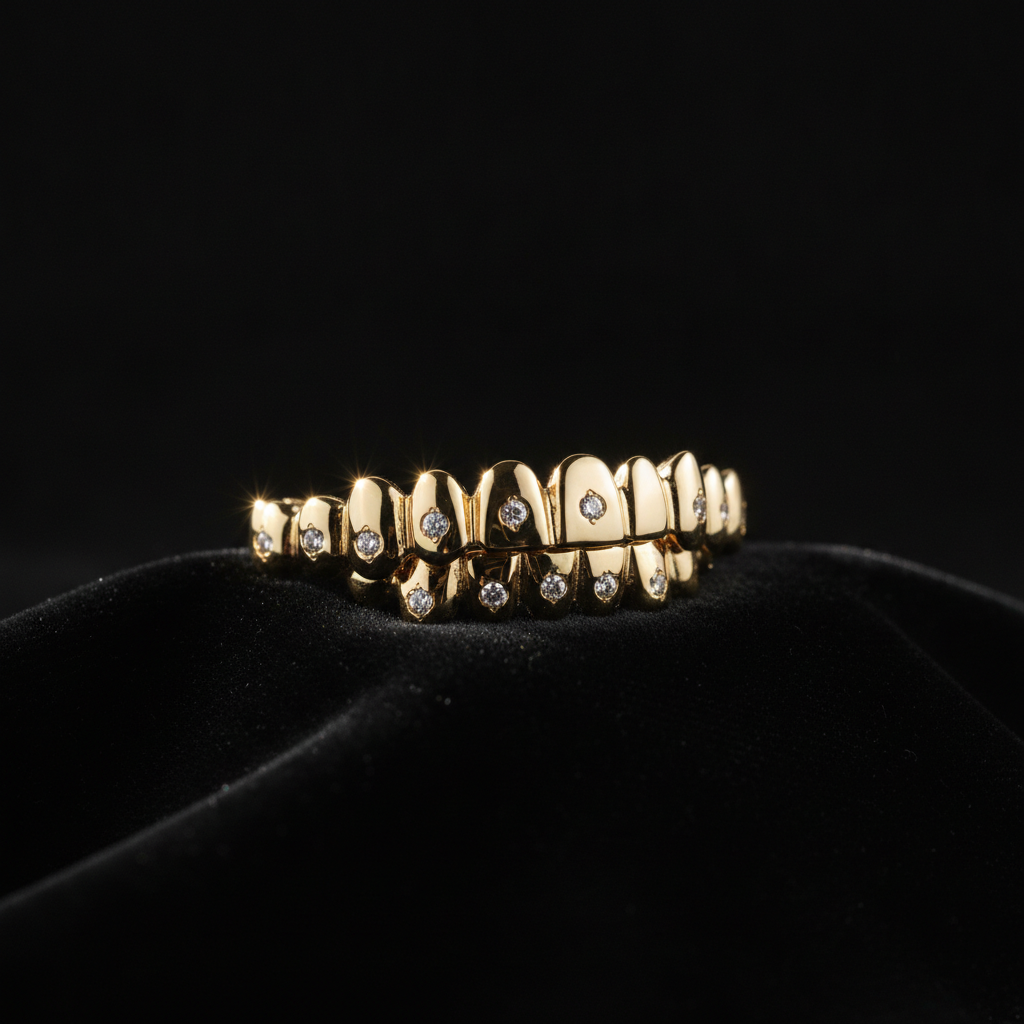
Here's what we're quoting in 2026 for Ventura and across California:
| Material | Single Tooth | Six Teeth | Full Set (8–10 teeth) |
|---|---|---|---|
| 10k Gold | Around $250–$400 | Around $900–$1,600 | Around $1,600–$2,800 |
| 14k Gold | Around $350–$550 | Around $1,300–$2,300 | Around $2,300–$4,000 |
| 18k Gold | Around $500–$850 | Around $1,900–$3,400 | Around $3,400–$6,000 |
| Rose / White Gold | Around $400–$650 | Around $1,500–$2,600 | Around $2,600–$4,600 |
| Diamond Dust Finish | Add around $150–$350 | Add around $300–$800 | Add around $700–$1,500 |
| Natural VVS Diamonds | Around $900–$2,000+ | Around $3,000–$7,500+ | Around $6,000–$15,000+ |
These are estimates, not fixed prices. Gold is a commodity. The London Bullion Market price shifts hourly, and every casting is weighed to the gram.
If the metal market spikes between your consultation and your fabrication week, the range nudges up. If it dips, you might land on the lower end. We quote real numbers after your impression is scanned and the CAD file exports final tooth geometry.
Gold grillz pricing in Ventura County isn't arbitrary. Four things dictate the final tab.
Karat weight. 10k gold is 41.7% pure gold by mass; the rest is alloy—copper, silver, zinc—for hardness. It's durable, lighter on the wallet, and the most popular choice for first-time clients in Oxnard and Thousand Oaks.
14k sits at 58.3% pure gold, richer color, still tough. 18k is 75% pure gold—buttery, heavy, noticeably softer to the bite. The purer the gold, the heavier the casting and the higher the melt loss during fabrication.
Number of teeth. A single canine might weigh two grams. A full upper eight-tooth set can hit fifteen grams or more, depending on how much labial surface you want covered. More metal means more cost, and the math isn't linear—full sets require indexing every interdental contact so they seat without binding.
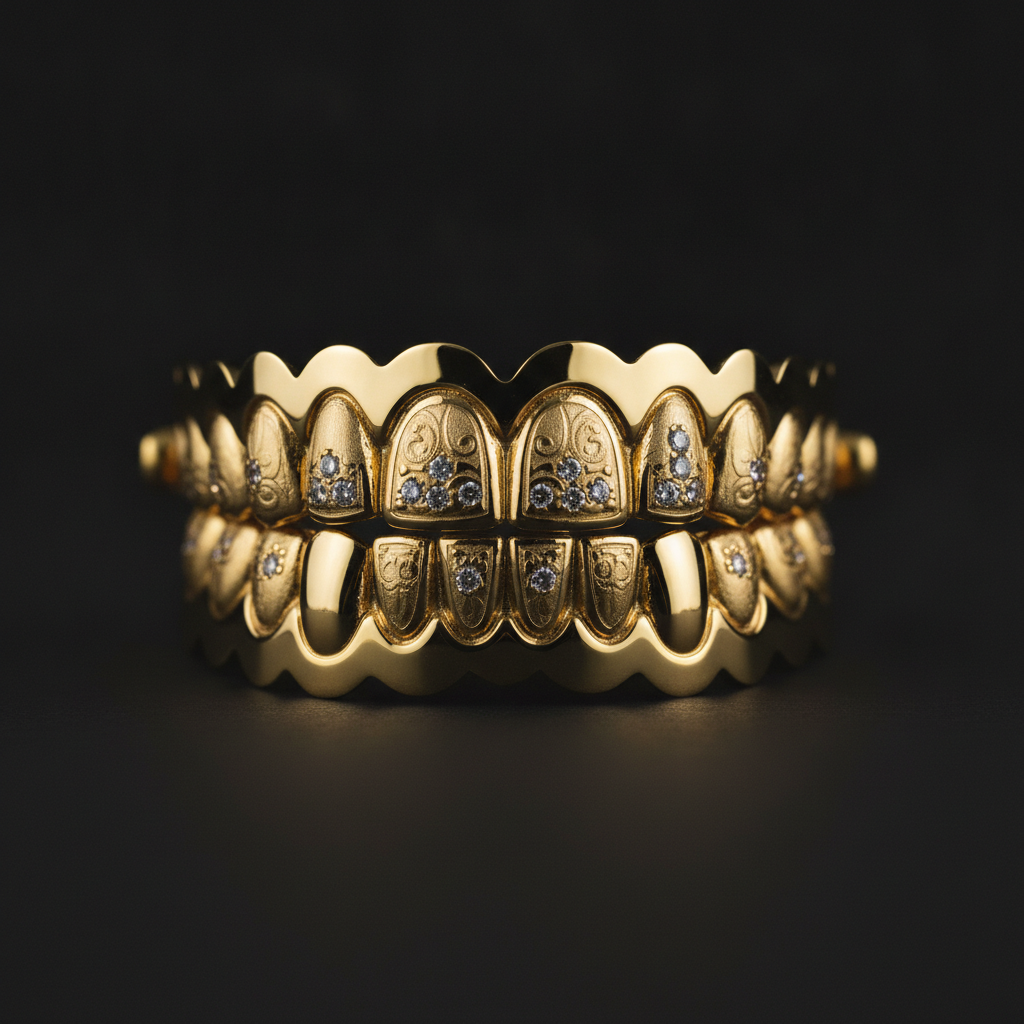
Design complexity. Smooth high-polish caps are faster to mill and finish. Diamond dust, open-face cuts, custom logos, or hand-engraved patterns add labor hours. Each design choice layers onto the base gold cost.
Ventura's gold market. We buy certified bullion through California suppliers. Gold hit near-record territory in late 2025 and hasn't pulled back much in 2026.
That reality trickles down to every dentist-fitted grillz studio from Los Angeles to Santa Paula. When the spot price climbs three percent in a week, your six-tooth 14k quote climbs with it.
You can buy a $30 boil-and-bite mold kit online, press it against your teeth at home, mail it to a lab you've never met, and wait for something gold-toned to arrive. We've seen those pieces. They gap at the gingival margin. They rock when you talk.
The metal is often gold-plated brass or low-karat mystery alloy.
Dentist-fitted grillz are different in every measurable way. Our licensed dentists use alginate impression trays—the same material used for crowns and orthodontic models.
The tray locks around your arch for ninety seconds while the alginate sets. You rinse, we pour dental stone, and within hours we have a dimensionally stable cast that captures every cusp tip, embrasure, and undercut. That model goes to our bench, where the wax-up is carved, the sprue is attached, and the casting is done in a centrifugal furnace that hits 1,950°F for 18k gold.
The result snaps into place with zero adhesive, seats flush against enamel, and comes off whenever you want.
Mail-order kits can't replicate that fit. They can't verify your bite. And if something feels wrong, you're texting a customer-service email, not sitting in a Ventura operatory where a licensed dentist adjusts the clasp with a handpiece in real time.
Longevity matters too. Solid 10k or 14k gold won't tarnish, won't flake, and won't turn your gums green. Plated kits start to shed their finish in weeks, especially if you wear them while eating or leave them in overnight—which you should never do, regardless of material.
Karat designation tells you purity, but each alloy behaves differently on your teeth.
10k gold is the workhorse. It's pale yellow, hard enough to resist scratches, and light enough that a full set won't fatigue your jaw. Most clients in Port Hueneme and Newbury Park go 10k for their first set.
The alloy mix usually includes copper and silver, which makes it stiff and less prone to bending if you accidentally bite down.
14k gold is the middle luxury tier. Richer yellow, noticeably heavier in hand, still tough enough for daily wear. The extra gold content gives a warmer glow under indoor light, and it's the sweet spot for people who want that unmistakable gold look without the softness of 18k.
This is our most requested upgrade after clients wear 10k for a year and want something deeper in tone.
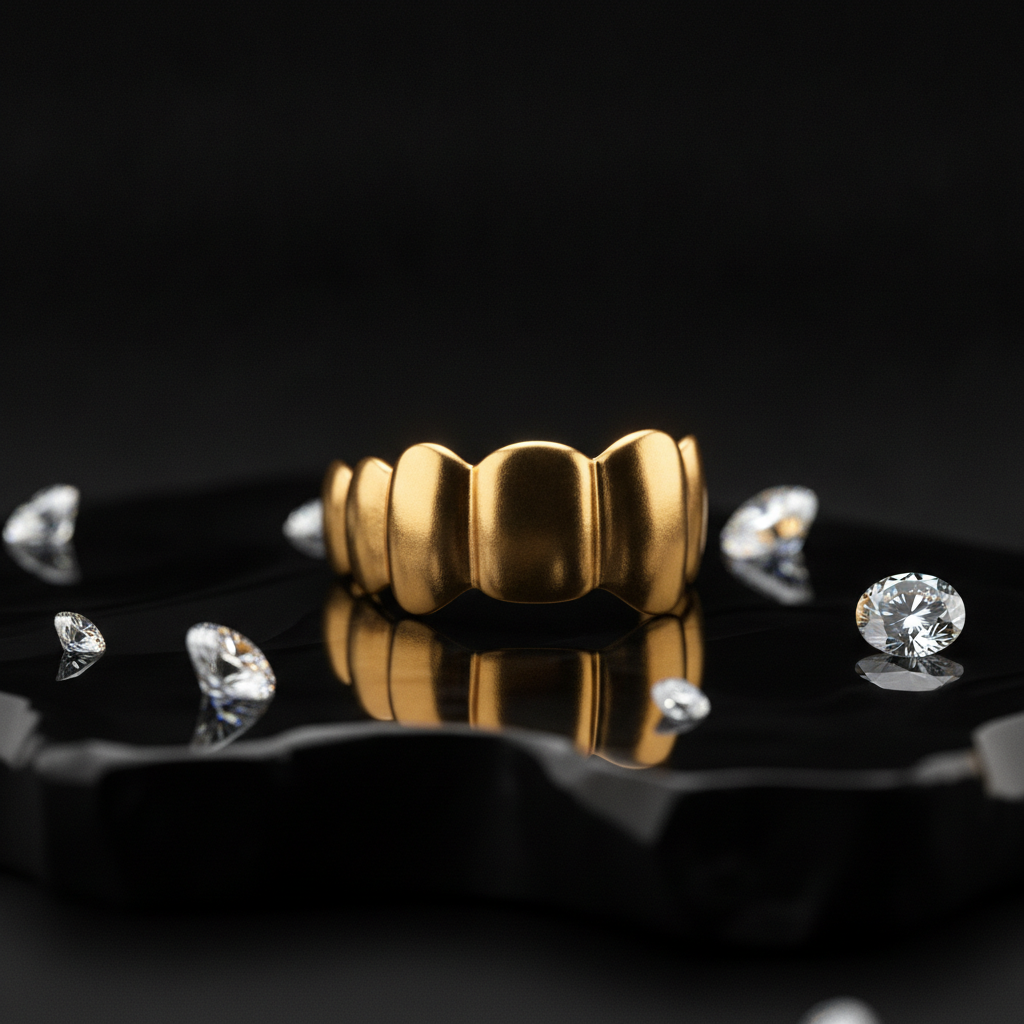
18k gold is soft, heavy, and unmistakably premium. You'll feel the weight difference the moment it seats. The color is sunset yellow, almost orange in certain light.
Because 75% of the alloy is pure gold, it's more malleable—you can dent it if you grind your teeth at night or bite into something hard. We usually recommend 18k for special-occasion sets or for clients who already know they love the heft.
Rose gold blends gold with a higher copper ratio, giving it that pinkish blush. It's become wildly popular in the last two years, especially among clients who want a softer, less-expected look. The durability sits between 14k and 18k yellow, depending on the exact recipe, and the price typically mirrors 14k or lands slightly higher due to alloy prep.
White gold mixes gold with palladium or nickel (we use palladium to avoid nickel allergies), then rhodium-plates the surface for that bright platinum look. It's striking, modern, and pairs well with diamond dust or VS stones.
The rhodium layer does wear over time—plan to have it re-plated every couple of years if you wear the set often. Cost-wise, white and rose gold land in the same ballpark, around $400–$650 for a single tooth and $2,600–$4,600 for a full set.
Plain gold is clean. Diamonds make it unforgettable.
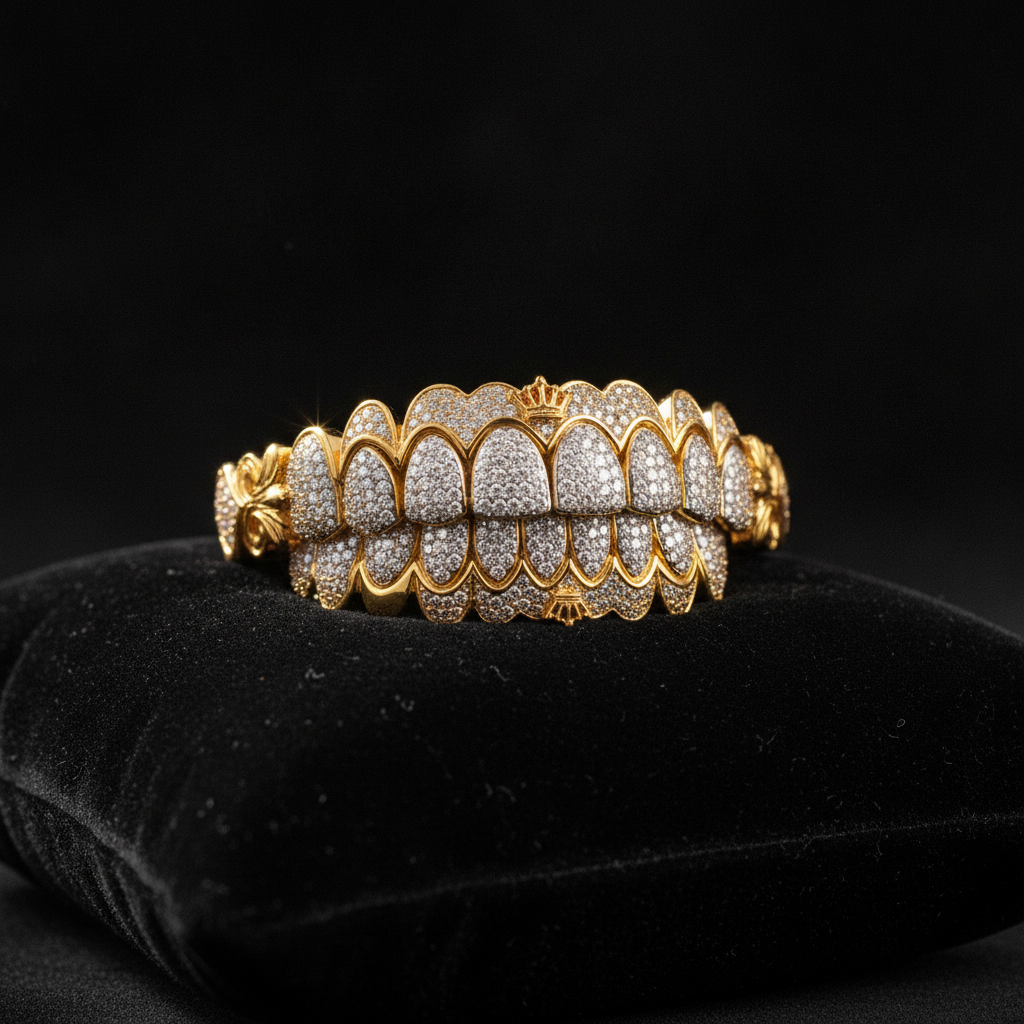
Diamond dust finish is crushed diamond aggregate mixed into a resin binder, hand-applied to the labial gold surface, then heat-cured. The result is a matte sparkle that catches every angle of light without the expense of setting individual stones. For a single tooth, expect to add around $150–$350.
For a full set, you're looking at an additional $700–$1,500, depending on how much surface area gets dusted. The finish is durable—it won't wash off—but it will dull slightly over months of wear. You can have it reapplied during a return visit.
Natural VVS diamonds are a different tier entirely. We source VS and VVS clarity stones—very slight inclusions or better—in sizes from 1mm to 3mm, set them in prong or pave mounts, and solder them into the gold casting before final polish.
A single tooth with three 1.5mm VVS rounds runs around $900–$2,000. A six-tooth set with mixed-size pave can hit $3,000–$7,500. Full sets with heavy stone coverage climb past $6,000 and top out above $15,000 when clients request larger center stones or fancy cuts.
Diamond grillz aren't subtle. They're meant to be seen from across a room. If that's your goal, budget accordingly and know that the stones add both cost and care—prongs can catch on fabric, and you'll want to store the set in a padded case when you're not wearing it.
The process starts with a consultation. You sit down in one of our Ventura County dental operatories—we serve Oxnard, Ventura, Thousand Oaks, and surrounding cities—and talk through what you want: karat, coverage, finish, timeline.
Our licensed dentists show you physical samples of 10k, 14k, and 18k gold so you can feel the weight difference. No pressure, no upsell. Just options.
Next comes the impression. The dentist loads a disposable tray with alginate, seats it over your upper or lower arch, and holds it steady for about ninety seconds while the material sets. It tastes like mint-flavored clay and feels cool.
You'll salivate—that's normal—and you breathe through your nose. Once it's firm, the tray pulls free with a quick snap, capturing every detail down to the perikymata on your enamel.
We pour the impression in dental stone, let it cure overnight, then scan the model or hand-carve the wax pattern, depending on design complexity. The wax goes into an investment mold, burns out in a kiln, and the void is filled with molten gold in a spin caster.
After quenching, we cut the sprue, grind the margins, pre-polish, and check fit on the stone model.
You return for a try-in appointment. The grillz should slide on with light finger pressure and stay put when you open your mouth. If any tooth binds, the dentist adjusts it chairside with a burr.
If the clasp is too loose, we tighten the retentive arms. Once the fit is perfect, we take the piece back for final high-polish and any stone setting.
Total turnaround is typically two to three weeks from impression to delivery, sometimes faster for single-tooth caps, occasionally longer if you've requested complex pave work or custom engraving. You leave with your grillz, a microfiber storage pouch, and care instructions: remove them before bed, brush them daily with non-abrasive soap and a soft brush, never sleep in them, never eat with them in unless you're prepared to clean them immediately after.
California regulates dental labs and dental offices. Working with a licensed dentist means you're inside that system. The materials are traceable.
The lab follows OSHA and CDC guidelines. If something goes wrong—if a clasp breaks, if the fit changes after a filling—you call the office, schedule an adjustment visit, and a licensed professional handles it.
Contrast that with out-of-state online sellers who operate in regulatory gray zones. If your mail-order grillz crack, you're shipping them back and waiting weeks for a remake. If they irritate your gingiva, you're on your own.
Ventura County clients also benefit from proximity. You can stop by for a polish between wears. You can consult on design tweaks face-to-face.
And if you want to add a second set in a different karat or upgrade from diamond dust to stones, the dentist already has your master model on file—no new impression needed.
Craftsmanship matters too. Our bench technicians have decades of combined experience in dental casting and jewelry-grade finishing. The solder joints are invisible. The polish is mirror-bright. The clasps grip without gouging enamel.
That level of work doesn't come from an automated overseas facility processing fifty orders a day.
Gold closed 2025 near all-time highs—above $2,050 per troy ounce—and has hovered in that range through early 2026. Central bank buying, inflation hedging, and geopolitical uncertainty keep upward pressure on the spot price. For custom grillz studios, that translates directly to material cost.
In Los Angeles and Ventura County, the markup structure is similar across reputable dental offices: raw gold cost plus labor, plus overhead, plus a margin that keeps the lights on and the autoclaves running. When spot gold jumps ten percent, your final quote will reflect a portion of that increase—usually not the full ten percent, because labor and fixed costs don't fluctuate with metal markets, but enough that you'll notice.
We track the London Bullion Market daily and update our estimate ranges every quarter. The numbers in this guide reflect April 2026 benchmarks.
By summer, they may tick up or down depending on Federal Reserve policy, international demand, and mine output. If you're planning a big diamond-set full-upper, lock in your consultation sooner rather than later—material costs don't wait.
Ventura's local economy also plays a role. Rent, wages, and business licensing fees are lower here than in Beverly Hills or West Hollywood, so our overhead is leaner and our pricing stays competitive with LA without sacrificing quality. Clients routinely drive from Santa Paula or even Simi Valley because they know they're getting dentist-grade work at transparent prices.
If you're ready to move past online kits and mail-order guesswork, book a consultation with Dental Grills Lab. Our licensed dentists serve Oxnard, Ventura, Port Hueneme, Newbury Park, Thousand Oaks, Santa Paula, and the rest of Ventura County.
You'll sit down, talk budget and design, and walk out with a clear estimate—no surprises, no pressure.
Bring questions. Bring reference photos. Bring a friend if you want a second opinion on whether 14k or 18k looks better against your skin tone. We've done hundreds of sets, and every one started with a conversation and a ninety-second impression.
Yours can too.
Four main factors dictate the cost: karat weight (10k, 14k, 18k), the number of teeth covered, design complexity, and the current market price of gold. Higher karat, more teeth, or intricate designs will increase the overall price.
10k gold is the most affordable, starting around $250–$400 for a single tooth. 14k is mid-range, around $350–$550 for a single. 18k gold is premium, priced around $500–$850 for a single tooth due to its higher purity and weight.
Diamond dust finishes add around $150–$350 for a single tooth or $700–$1,500 for a full set. Natural VVS diamond settings are significantly more, starting around $900–$2,000+ for a single tooth and $6,000–$15,000+ for a full set, depending on stone size and coverage.
The process begins with a consultation and a precise, chairside impression taken by a licensed dentist. Next, your custom grillz are fabricated from solid karat gold. Finally, you return for a try-in and any necessary adjustments to ensure a perfect, comfortable fit.
Dentist-fitted grillz from Dental Grills Lab ensure a precise, comfortable fit using professional dental impressions and solid karat gold. Online kits often use plated metals and ill-fitting boil-and-bite molds, leading to poor quality, hygiene issues, and discomfort.
Total turnaround from your initial impression to final delivery is typically two to three weeks. Simpler designs, like single-tooth caps, might be completed faster, while complex pave work or custom engraving could extend the timeline slightly.
Yes, Dental Grills Lab offers both rose and white gold options. A single tooth in rose or white gold costs around $400–$650, while a full set ranges approximately $2,600–$4,600. White gold is rhodium-plated for that bright, platinum-like appearance.
Dental Grills Lab proudly serves all of Ventura County. This includes cities such as Oxnard, Ventura, Port Hueneme, Newbury Park, Thousand Oaks, and Santa Paula, providing dentist-fitted custom grillz services to the entire region.